A chimney cap is the metal cover over the flue opening at the top of the chimney; it keeps rain, snow, leaves, and birds out and stops sparks from landing on the roof. New Britain sees strong nor'easter gusts and…
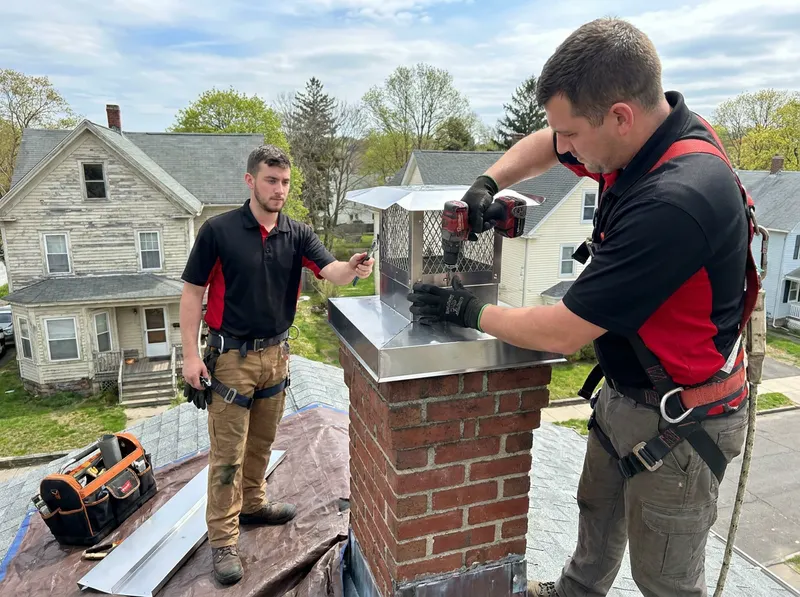
A chimney cap is the metal cover over the flue opening at the top of the chimney; it keeps rain, snow, leaves, and birds out and stops sparks from landing on the roof. New Britain sees strong nor'easter gusts and freeze-thaw cycles that loosen fasteners and lift caps clean off the crown, a common call across Belvidere, the East Side, and the older housing stock near Broad Street District where original caps have corroded. When wind has blown a chimney cap back from the chimney, the fix is often reattachment with new stainless fasteners rather than a full replacement, provided the cap itself is straight and unrusted.
Decision-fit comes down to the cap's condition. If the cap is intact and only worked loose, reattaching it with corrosion-resistant screws and a fresh bead of sealant is the lower-cost path. If the mesh is torn, the top plate is dented, or rust has eaten through, a damaged chimney cap that no longer sits flush, replacement is the durable answer, and a stainless-steel or copper cap outlasts the galvanized units that fail after roughly 5, 10 years in Connecticut weather. On older masonry chimneys around Walnut Hill and Osgood Hill, the concrete crown beneath the cap often cracks from freeze-thaw; chimney crown repair seals those cracks with a flexible crown coat so water stops seeping into the brick and joints below.
The number of flues sets the cap type. A single-flue cap clamps or screws to one tile liner and is the common fit on a straight fireplace flue. A multi-flue cap is a larger custom hood that covers the entire crown when a chimney vents both a fireplace and a furnace, frequent on two-flue chimneys in Corbin Heights and Stanley Quarter homes. The trade-off is cost and lead time: a stock single-flue cap installs same-visit, while a custom multi-flue cap is measured on-site and fabricated first.
Cap and crown condition are documented under the Level 1 inspection defined by NFPA 211, the National Fire Protection Association standard for chimney maintenance, and the Chimney Safety Institute of America (CSIA) lists a missing or damaged cap as a direct cause of water damage and flue deterioration. A Level 2 inspection applies when a cap failure coincides with a property sale or a known flue problem. Every job starts with a free on-site estimate, a technician gets on the roof, photographs the cap and crown, and confirms whether the fix is a reattachment, a replacement, or a crown seal before quoting. There is no charge to take a look at a damaged chimney cap and tell you plainly what it needs.
Every job gets a firm, written price after a free on-site visit.
Tell us about your chimney cap repair & replacement job in New Britain and we'll send a clear, written quote, usually the same day.
 Flueking Chimney Sweep