A chimney with a bird, a squirrel, or a raccoon inside signals a missing or damaged cap. To remove a bird from a chimney, the flue is checked with a camera first: live birds trapped above a closed damper often flew…
A chimney with a bird, a squirrel, or a raccoon inside signals a missing or damaged cap. To remove a bird from a chimney, the flue is checked with a camera first: live birds trapped above a closed damper often flew down and cannot climb the smooth liner back out, while chimney swifts are a federally protected migratory species and their active nests cannot be disturbed until the young have fledged. A nest is a fire hazard because twigs and dried grass sit directly in the smoke path; NFPA 211 treats obstructions like this as a condition requiring the flue be cleared before use. Once the nest is removed and the animal is out, the chimney is swept clean of the debris left behind so the firebox and liner are clear.
Raccoons are the heavier problem on older New Britain homes. A mother raccoon will den on the smoke shelf just above the damper in the Belvidere and West End neighborhoods, where 1920s masonry chimneys often have wide clay flues and no cap. Removal waits until any kits are mobile, because sealing an adult out while young remain inside traps them. To keep raccoons out of a chimney permanently, the fix is a locked stainless cap over the flue, not a temporary screen; a raccoon can pry off a loose or aluminum cap. That is where the spark arrestor does double duty.
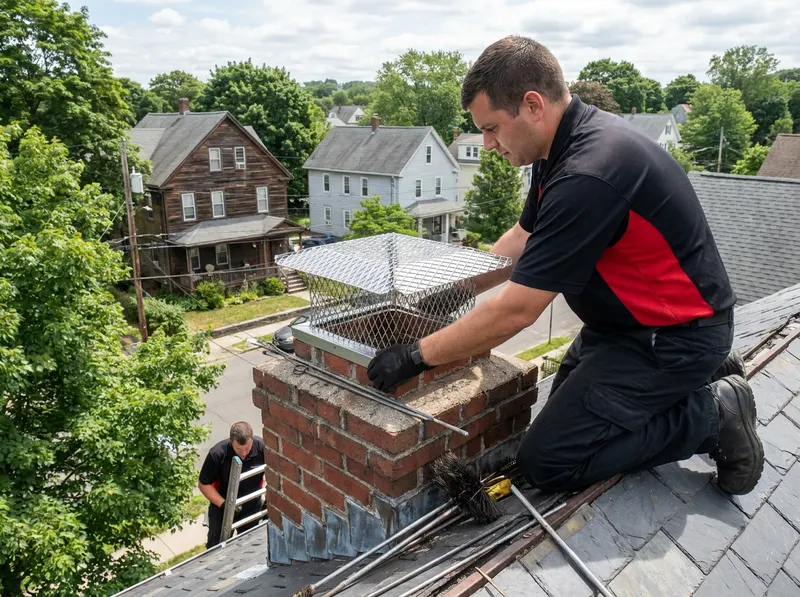
A spark arrestor is a mesh cage over the flue opening that stops embers from landing on the roof and blocks animals from entering. The recommended build is a custom, 316 stainless steel mesh animal spark arrestor sized to the exact flue tile, because 316 stainless resists corrosion from the sulfur and moisture in wood and pellet smoke better than aluminum or galvanized steel, which rust and fail within a few seasons. The mesh spacing meets the standard reference of roughly 3/8-inch to 1/2-inch openings, small enough to stop sparks and birds yet open enough to draft. A single-flue standard cap is a stock fit; a custom chimney animal guard is fabricated when the crown holds multiple flues or an unusual oversized tile, common on the multi-family houses around the East Side and Broad Street District.
Decide by what is happening. If an animal is stuck right now and the flue is otherwise sound, animal removal plus a cleanout is the whole job. If animals keep returning to homes in Corbin Heights, Osgood Hill, or the Vine Street area, the flue needs a cap because an open flue is an open door. If a chimney fire or fresh water stain is present alongside the animal, a CSIA-referenced Level 2 inspection with a camera scan is warranted rather than a Level 1 visual check, since heat and moisture can crack the liner. It is reasonable to get some quotes before choosing, and any estimate should list removal, cleanout, and cap cost as separate lines so nothing is bundled or padded.
Every job gets a firm, written price after a free on-site visit.
Tell us about your animal removal & spark arrestor job in New Britain and we'll send a clear, written quote, usually the same day.
 Flueking Chimney Sweep